
November 19, 2026
Patient Voices on What Cure Could Mean for the Myeloma Community
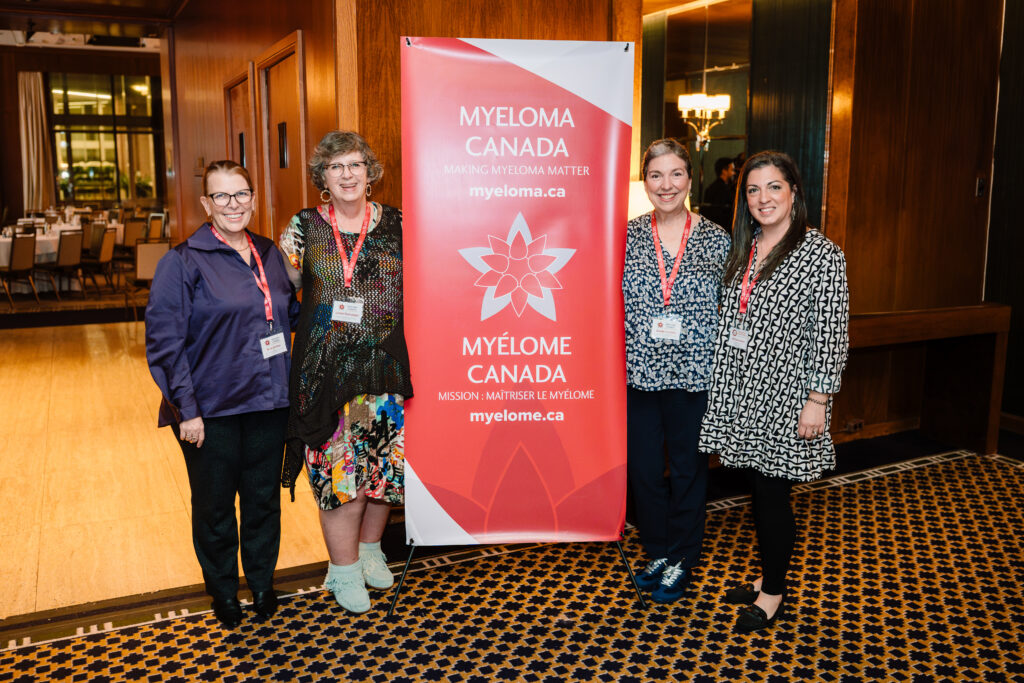
On November 6th at the Myeloma Canada Scientific Roundtable, three Canadian patients took the stage to do something rarely done in that setting: speak directly to the researchers, clinicians, and policymakers gathered to define what cure means.
The panel, moderated by Myeloma Canada’s Michelle Oana, featured Gisèle Fournier of Montreal, QC, Rinat Avitzur of Toronto, ON, and Lorelei Dalrymple of Okotoks, AB. Between them, they represent decades of lived experience with multiple myeloma.
The theme of the panel was “Patient perspectives on cure,” a timely and critical topic given the ongoing conversations around the definition of cure that the research community has been having (see the International Myeloma Society’s for a summary of the definition presented at their annual meeting). Rinat, Gisèle, and Lorelei shone a light on the implications that a definition could have on patients’ lived experience.
“Cure,” a word that holds a lot of weight
Michelle Oana opened the session by recognizing the tremendous hope that the possibility of cure brings to patients and expressing gratitude to the research community for its ambition and commitment to making it a reality. She also acknowledged the expectations, emotions, and questions that come with the word, emphasizing that the patient experience must remain central to discussions of what cure means, both at the meeting and beyond. For the last few months, the scientific community has discussed the emerging definition of cure in myeloma in scientific forums, a milestone that would have been unthinkable a decade ago.
“Although we’re beyond thrilled to be having these discussions, that word holds a lot of weight,” Michelle said. “It can be anxiety-inducing, bring up a lot of emotions, a lot of questions.”
Gisèle Fournier reached complete remission for the first time in six and a half years following CAR T therapy on a clinical trial. For her, the definition of cure comes down to something both simple and profound. “Duration is at the heart of it,” she said. “I aspire to regain a reasonable, healthy life expectancy, so that I can continue to contribute to society, to my community, to my family…to continue to have a purpose and to be actively involved.”
Cure vs. not cured: More than a binary
One of the strongest themes of the discussion was the danger of a cure definition that leaves patients in an either/or category. Rinat Avitzur, who has been MRD negative for over two years on a clinical trial following a tandem stem cell transplant, was direct about what she needs from the conversation going forward. “I want to make sure we don’t have a dichotomous definition — you’re either cured or not — because there’s so much in between,” she said.
Rinat also spoke to the anxiety that accompanies the prospect of stopping treatment, something the emerging definition of cure will inevitably require clinicians to discuss with their patients. “We tolerate treatment because we have to, not because we like it,” she said. “But it’s a completely different life without medications, and there’s a lot of anxiety around stopping them.”
Poking the bear
Lorelei Dalrymple has been living with myeloma since 2009 and has been on daratumumab for nearly a decade. She offered one of the session’s most candid reflections on the prospect of treatment-free survival. “If somebody could tell me I could safely stop, I would say let’s stop today,” Lorelei said. “But I need to know what steps are going to be in place to make sure there isn’t disease progression, or that we’re catching it early.”
Both Lorelei and Michelle described a conversation from the recent Myeloma Canada Support Group Leaders’ Summit where participants wrestled with the same question. The analogy that resonated most: Linus from Peanuts, and his security blanket. Lorelei went on to say, “I need to know that I’m still going to be looked after and have access to treatments down the road.”
Trust, fear, and the relationship with the care team
During the Q&A, a clinician in the audience asked whether knowing a definition of cure existed would have changed any of the treatment decisions the panelists made in the past. The answers were illuminating, highlighting the importance of the relationship between patient and their care team.
Lorelei reflected on her own limited options at diagnosis. “You do what you need to do because you want to make it to the next level,” she said. “As long as there’s hope, myeloma patients will tolerate an awful lot.”
Rinat described her relationship with her physician as one built on deep trust, but not one in which she wants to hold the wheel alone. “When I see my doctor, I may look like an adult walking in, but inside I’m a five-year-old, and I put myself in her hands,” she said.
Gisèle offered a perspective that acknowledged the full spectrum of patients. “There are many patients who may not be ready to take a lot of risks,” she said. “The perception of the burden of treatment is very individual.”
The session closed with a question from an audience member about what it would mean to be discharged from the cancer centre. All three panelists answered with some version of the same word: terrifying.
“To cut that relationship off is very terrifying,” said Lorelei. “But would I do it? Probably yes, in a heartbeat, as long as you’re still monitoring me.”
Rinat put it plainly: “I would be afraid to be sent to someone who doesn’t understand myeloma.”
And Gisèle, still navigating her first complete remission, spoke for many: “I’m completely terrified that it won’t last. I’m not yet envisioning cutting the links with my team.”
The message to the room was clear: the science is moving, the definition is being written, and the patients are watching, and they want a seat at the table as the implications of this emerging scientific definition reach the real world.